

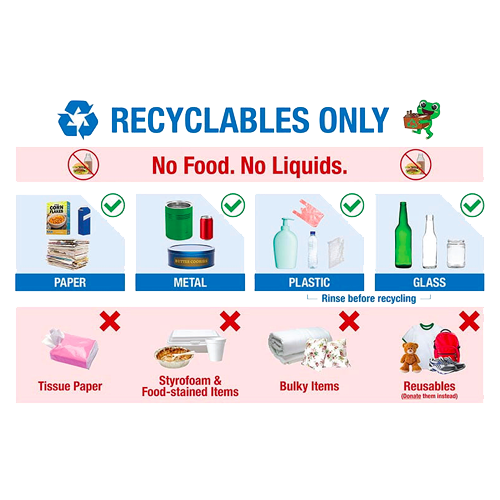
Dimensions:
- Small - W220 x L530mm
- Large - W450 x L750mm
Image for illustrative purposes only
*Due to the many variations in monitors and browsers, color samples may appear different on different monitors
-----
Complete Guide to the AUSKO Co Mingle Sticker
Co-mingled recycling systems—where paper, plastics, glass, and metal cans are collected together in a single container—are one of the most popular ways to boost recycling participation. However, without clear visual identification, users often confuse co-mingled recycling bins with general landfill bins, leading to heavy contamination from food waste and non-recyclable refuse.
The AUSKO Co Mingle Sticker is a high-visibility, professional visual labeling solution designed to clearly mark single-stream and co-mingled recycling collection points. Offered in two distinct size profiles—Small (W220 × L530 mm) and Large (W450 × L750 mm)—these adhesive labels eliminate user confusion, streamline waste sorting, and support organizational sustainability targets.
This guide covers everything you need to know about the AUSKO Co Mingle Sticker—including sizing specifications, material properties, sector-specific uses, application guidelines, and preventative maintenance protocols.
What Is the AUSKO Co Mingle Sticker?
The AUSKO Co Mingle Sticker is a heavy-duty, adhesive visual label engineered specifically for mounting onto Mobile Garbage Bins (MGBs), indoor/outdoor recycling stations, office waste receptacles, and industrial material containers.
Rather than serving merely as decorative tags, Co Mingle stickers fulfill essential behavioral and operational functions:
-
Co-Mingled Stream Identification: Clearly designates bins intended for combined recyclable materials (such as paper, plastics, aluminum cans, and glass bottles), matching single-stream municipal and commercial collection services.
-
Dual-Sizing Versatility: Offers matching Small and Large formats to create cohesive visual labeling across both large outdoor wheelie bins and indoor pantry receptacles.
-
Instant Visual Nudging: Combines distinct color categories with graphic iconography, allowing users to identify the correct disposal bin within milliseconds without reading lengthy text.
-
Contamination Reduction: By clearly defining what materials belong in each specific container, these labels prevent non-recyclable items from entering clean material streams.
-
Standardization Across Facilities: Provides a uniform visual appearance across large campuses, office buildings, or factory floors, establishing consistent recycling habits for employees, students, and visitors.
-
Regulatory & ESG Compliance: Helps businesses meet municipal waste sorting regulations, corporate ESG (Environmental, Social, and Governance) benchmarks, and green building certification requirements.
Key Features & Size Specifications
Communication effectiveness depends on clarity, durability, and fitting the specific bin dimensions used in your facility layout.
Available Sizes & Dimensions
-
Small (W220 mm × L530 mm): Ideal for small office pantry bins, indoor recycling boxes, under-desk containers, and narrow station slots.
-
Large (W450 mm × L750 mm): Ideal for standard 120L, 240L, and 360L wheelie bins, bulk MGBs, and outdoor recycling stations.
Performance Advantages
-
High-Contrast Graphics: Uses bold iconography that transcends language barriers in multicultural workplaces and public venues.
-
Heavy-Duty Vinyl Base: Manufactured from flexible, tear-resistant vinyl that conforms smoothly to flat or slightly curved bin surfaces (plastic, stainless steel, or powder-coated metal).
-
Aggressive Adhesive Backing: Formulated with a permanent acrylic pressure-sensitive adhesive that bonds securely to low-surface-energy plastics (like HDPE and polypropylene wheelie bins) without peeling at the corners.
-
Wipe-Clean Laminated Surface: Sealed with a clear protective film that shields printed inks from UV fading, scratches, chemical disinfectants, and liquid splatters, allowing janitorial staff to wipe off dirt and sticky residue easily.
Unlabeled Bins vs. Bins Fitted with AUSKO Co Mingle Sticker
Operating waste disposal areas without clear visual labeling leads to severe sorting errors, high contamination rates, and increased disposal costs.
-
Sorting Accuracy: Unlabeled bins rely on guessing, leading to poor sorting. Bins with Co Mingle stickers provide high accuracy via clear visual guidance.
-
Material Contamination: Unlabeled bins carry a high risk of food waste ruining clean recyclables. Co Mingle stickers drastically reduce contamination rates.
-
Facility Appearance: Unlabeled areas look unprofessional, cluttered, or messy. Co Mingle stickers create a standardized, professional, and organized appearance.
-
User Decision Time: Unlabeled bins cause hesitation at disposal points. Co Mingle stickers enable immediate visual identification.
-
Recycling Pureness: Unlabeled bins produce low-purity streams rejected by contractors. Co Mingle stickers yield high-purity clean streams ready for processing.
-
Management Efficiency: Unlabeled systems lead to higher sorting costs and extra municipal fees. Co Mingle stickers enable more efficient, lower-cost waste management.
What Goes into Co-Mingled Recycling?
A co-mingled recycling stream allows multiple dry recyclable materials to be combined in a single collection bin:
-
Paper & Cardboard: Office paper, envelopes, newspapers, magazines, and flattened cardboard packaging.
-
Plastics & Bottles: PET drink bottles, HDPE detergent jugs, plastic trays, and clean food containers.
-
Metal Cans: Aluminum drink cans, steel food tins, aerosol cans, and clean foil packaging.
-
Glass Bottles & Jars: Clean glass beverage bottles and food jars (where permitted by local recycling guidelines).
Sector-By-Sector Application Guide
Clear visual labeling is essential across high-traffic commercial, educational, industrial, and healthcare environments:
1. Corporate Offices, Pantries & Commercial Towers
-
Breakroom & Pantry Stations: Uses Small (W220 × L530 mm) stickers on pantry bins to collect mixed drink cans, bottles, and clean paper waste in one convenient spot.
-
Print & Photocopy Bays: Marks dedicated paper and packaging recycling hampers right next to high-volume printers.
2. Schools, Universities & Educational Institutions
-
Campus Canteens & Quadrangles: Teaches students responsible waste separation habits through easy-to-understand visual icons on high-capacity campus bins.
-
Classrooms & Libraries: Uses Small stickers to distinguish mixed recycling bins from general landfill rubbish.
3. Shopping Malls, Food Courts & Retail Parks
-
Public Recycling Bays: Deploys Large (W450 × L750 mm) stickers on bulk bins to guide shoppers to sort takeaway drink bottles, food packaging, and cans in high-traffic concourses.
4. Factories, Warehouses & Manufacturing Plants
-
Production Line Scrap Stations: Clearly labels industrial bins for mixed packaging waste, stretch wrap, plastic jugs, and metal containers.
-
Receiving Docks: Marks large 660L and 1100L bulk MGBs using Large Co Mingle stickers for consolidated recyclable material handling.
5. Hospitals, Healthcare & Laboratories
-
Non-Clinical Waste Separation: Separates general office and clean packaging recyclables from biohazardous clinical waste streams, ensuring strict regulatory compliance.
Step-by-Step Application & Mounting Protocol
Proper surface preparation ensures the acrylic pressure-sensitive adhesive forms a permanent, bubble-free bond with the bin surface.
Step 1: Gather Materials
Before application, ensure you have:
-
The appropriate AUSKO Co Mingle Sticker (Small or Large)
-
Isopropyl alcohol (or mild degreasing detergent) and a lint-free microfiber cloth
-
Measuring tape and pencil/marker (for alignment)
-
Squeegee or plastic card (for smoothing out air bubbles)
-
Masking tape (optional position guide)
Step 2: Thoroughly Clean the Mounting Surface
-
Wash off dust, oil, grease, or sticky residue from the bin surface using warm water and soap.
-
Perform a final wipe down using isopropyl alcohol and a dry microfiber cloth to remove all microscopic oils and cleaning films.
-
Crucial Note: Ensure the surface is 100% dry before applying the sticker. Adhesive will not bond to damp surfaces.
Step 3: Measure and Align Position
-
Position the sticker on the front face or lid of the bin at eye level or centered above the disposal opening.
-
Use a tape measure to confirm the label is level and centered. Secure the top edge temporarily with a strip of masking tape if needed.
Step 4: Peel and Apply
-
Peel back 2 to 3 centimeters of the release paper from the top of the sticker.
-
Adhere the exposed top adhesive edge firmly onto the bin surface.
-
Slowly peel away the remaining backing paper downward with one hand while pressing the sticker onto the bin with a squeegee or microfiber cloth in smooth, overlapping side-to-side strokes.
Step 5: Remove Air Bubbles & Set
-
Firmly run the squeegee over the entire sticker surface from the center outward to push out trapped air bubbles and lock the pressure-sensitive adhesive onto the substrate.
-
Allow the adhesive to cure for 24 hours at room temperature before exposing the bin to heavy washdowns or outdoor rain.
Preventative Maintenance & Care Protocol
Keeping recycling stickers clean and readable ensures long-term performance and maintains a professional facility appearance.
Daily to Weekly Maintenance
-
Wipe Clean During Routine Janitorial Care: Wipe the laminated sticker surface with a damp microfiber cloth and mild multi-surface cleaner to remove sticky drink splatters or dust.
-
Avoid Abrasive Scrapers: Do not use metal wire brushes, steel wool, or razor blades to clean the sticker surface, as sharp tools can pierce the protective laminate film.
Monthly Inspection Checks
-
Inspect Edges: Check label corners to ensure adhesive remains intact. If an edge has lifted due to grease build-up, clean beneath it and press down firmly.
-
Inspect Legend Clarity: Ensure the graphics and text remain unobstructed by heavy grime or paint overspray in industrial yards.
Troubleshooting Common Issues
Use this guide to quickly diagnose and resolve common sticker application and durability problems.
Issue 1: Sticker Edges Are Peeling Off After Application
-
Likely Cause: The bin surface was dirty, oily, damp, or contaminated with silicone cleaner during installation.
-
Solution: Peel off the damaged sticker, thoroughly clean the plastic or metal substrate with isopropyl alcohol, let it dry completely, and apply a fresh sticker.
-
Issue 2: Air Bubbles Trapped Beneath the Vinyl
-
Likely Cause: The sticker was slapped down all at once rather than smoothed on gradually with a squeegee.
-
Solution: For small bubbles, use a fine pin to poke a microscopic hole at the bubble edge and press the trapped air out flat with your thumb.
-
Issue 3: Selecting the Wrong Size for the Bin
-
Likely Cause: Using Small stickers on massive 1100L bulk bins, or Large stickers on narrow under-desk pantry bins.
-
Solution: Use Small (W220 × L530 mm) for indoor pantry/office receptacles under 60L, and Large (W450 × L750 mm) for standard wheelie bins (120L–360L) and bulk 4-wheel containers.
-
Frequently Asked Questions (FAQs)
Q1: What are the exact dimensions of the AUSKO Co Mingle Sticker?
The Co Mingle series is available in two standard sizes:
-
Large: W450 mm × L750 mm
-
Small: W220 mm × L530 mm
Q2: What does co-mingled recycling mean?
Co-mingled recycling means multiple types of clean recyclable materials—such as paper, plastic bottles, metal cans, and glass—are collected together in one single bin rather than separate individual bins.
Q3: What surfaces can the Co Mingle sticker be applied to?
It can be applied to clean, smooth surfaces including plastic (HDPE/PP) wheelie bins, stainless steel containers, powder-coated metal recycling stations, and composite material bins.
Q4: Can these stickers be applied to outdoor wheelie bins?
Yes. The durable vinyl base and protective laminated overcoat resist UV fading, rain, wind, and outdoor temperature swings.
Q5: Can the stickers be cleaned with standard commercial disinfectants?
Yes. The clear protective laminate overcoat prevents water, mild soaps, floor cleaners, and commercial spray disinfectants from reaching or dissolving the printed inks underneath.
Q6: What is the best height to place recycling stickers on wheelie bins?
Mount stickers on the upper front panel of the bin body (just below the handle or rim) or directly on the top lid surface so the visual label is immediately visible to someone approaching the bin.
Q7: Can these stickers be removed without damaging the bin surface?
Yes. If you need to rebrand or update a recycling station, heat the sticker gently with a hair dryer or heat gun to soften the acrylic adhesive, then peel the vinyl off carefully. Any residual adhesive can be wiped clear with isopropyl alcohol.